
Galangal, Ghost Kitchens and the Vanishing Soul of Thai Street Food in 2026
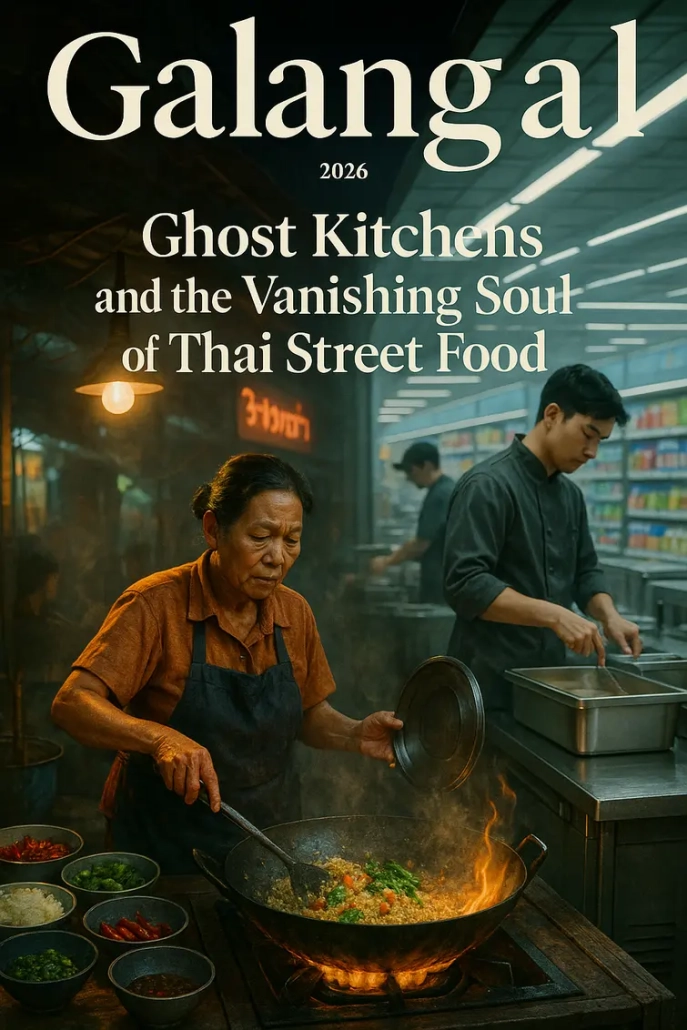
Somewhere between a smoky Bangkok alley and a fluorescent supermarket aisle in London, something strange happens to Thai street food. The sizzling woks, the nose-tingling bird’s eye chilies, the peppery bite of fresh galangal – all begin a long, complicated journey through warehouses, drones, customs checks and cold rooms. By the time they land in your neatly branded takeaway tub, you have to ask: is this still the real thing… or just a very convincing ghost?
In 2026, the global supply chain of Thai street food ingredients is no longer a simple story of farm to market. It’s a swirling maze of automated micro-hubs, AI-managed vertical farms, industrial pastes and underground ingredient smugglers who treat bird’s eye chilies the way some people treat contraband antiques. This is a story about culture, logistics and taste: how the soul of Thai cuisine travels, fractures and occasionally disappears between Bangkok and Birmingham.
Our focus keyword for this journey is global supply chain of Thai street food ingredients. We’ll follow galangal from heritage soil to industrial dehydrator, chase chilies through fragmented trade corridors, and peek inside the secret lives of cloud kitchens in London. Along the way, we’ll explore what ‘authenticity’ really means when a bowl of green curry can be assembled by a human in Isan, a robot arm in a UK dark kitchen, or a ghost kitchen in New York that no customer ever sees.
The Provocative Question: Is Your 2026 Thai Curry Lying to You?
Let’s start with a simple but rather cheeky question: is the Thai curry you are eating in 2026 telling you the truth? The menu might whisper about ‘authentic Bangkok flavours’, but authenticity has become a slippery thing in a world ruled by the global supply chain of Thai street food ingredients. Once upon a time, authenticity meant a grandmother in a Chiang Mai alley pounding curry paste in a granite mortar until her arms ached. Now it might mean a barcoded sack of standardized green paste frozen in a warehouse near Rotterdam.
Authenticity is not just about recipes. It is a historical and cultural agreement between land, people and time. The journey of ingredients such as galangal, lemongrass and bird’s eye chilies reflects power, trade empires and modern logistics technology as much as it reflects taste. When you put that spoonful of curry to your lips, you are, in some small way, tasting the politics of global shipping lanes and the economics of gig‑driven food delivery.
In 2026, this tension has sharpened. Fragmented trade corridors, shifting maritime routes, new tariffs and automated hubs have all begun to reshape how Thai ingredients move. Under industrial pressure, the global supply chain of Thai street food ingredients trims away what doesn’t fit neatly into a shipping algorithm: odd-looking roots, small irregular chilies, and anything that bruises too easily or refuses to ripen on schedule. The soul of Thai cuisine is not lost in one dramatic moment; it is quietly clipped, filtered and standardized until the flavours taste suspiciously well behaved.
The High-Stakes Battle for the Soul of Thai Cuisine
Imagine the world’s shipping lanes not as lines on a map but as enchanted rivers carrying aromatic cargo. Along these rivers floats the fate of dishes like tom yum, som tam and green curry. In this magical yet all-too-real landscape, the global supply chain of Thai street food ingredients becomes a battleground. On one side stand heritage farmers, keeping seeds passed down for generations and trusting the seasons more than software. On the other side, automated logistics hubs demand crops that are uniform, predictable and obedient.
The battle is subtle but high-stakes. Heritage galangal, with its wild, foresty perfume, is more fragile and less visually consistent than its high-yield cousins. Bird’s eye chilies grown in traditional plots have a mischievous Scoville variability: one might be playfully hot, the next positively infernal. Industrial buyers, however, prefer predictably medium heat, gentle flavours and roots that all look the same size for the scanners on automated grading lines. Flavour variation, once prized as a sign of life and terroir, begins to look like bad data.
All this means that the soul of Thai cuisine is now partly determined by software, shipping insurers and trade negotiators. That’s a rather unsettling thought, but also a fascinating one. The same historical forces that once sent spice-laden ships from Asia to European ports are still at work – only now they are accompanied by drones, AI, and biometric sensors measuring the ‘quality’ of each root of galangal as it rolls along a conveyor belt.
The Visual Contrast: Bangkok Alley vs Global Logistics Hub
Before we dive deeper into the global supply chain of Thai street food ingredients, it helps to picture two very different worlds side by side. In the first world, you’re in a Bangkok alley at dusk. Woks hiss like dragons, oil crackles, and the air hums with the sweet-sharp scent of garlic, chili and fish sauce. On a wooden table nearby, a vendor lays out knobbly galangal roots, lime leaves and fistfuls of bird’s eye chilies, still clinging to their stems.
In the second world, you’re in a 2026 logistics micro-hub. It could be in Singapore, Dubai or a nameless industrial suburb of London. Automated forklifts glide silently, robotic arms stack crates, and scanner lights flicker like a futuristic Northern Lights above pallets of vacuum-sealed herbs. Somewhere on a screen, an algorithm rates each batch of chilies according to size, colour, water content and projected shelf life.
When these two worlds touch, something magical and also slightly tragic happens. The alley’s chaotic beauty is translated into codes and standards: grade A, B, C; acceptable moisture range; permitted pesticide residue; ideal box dimensions. The question is not whether logistics are evil – they aren’t; they keep food moving and people fed – but whether, in this translation, some of the essence that made those alleyway dishes distinctive is quietly ironed out.
The Anatomy of a Disappearing Flavor: Galangal Under Pressure
To understand how the global supply chain of Thai street food ingredients can erode flavour, we need a small detour into the botany and chemistry of galangal. Galangal (kha in Thai) is a rhizome, a cousin of ginger, beloved for its sharp, citrusy, almost pine-like aroma. In classic tom yum, galangal is not merely a supporting act; it is a key note that holds the whole dish together. But not all galangal is created equal.
In 2026, food scientists and agronomists have started comparing the chemical profiles of galangal grown in different environments. Highland-grown galangal from heritage farms in northern Thailand, cultivated in rich, volcanic-influenced soil, tends to contain a more complex cocktail of aromatic compounds: more cineole here, more galangol there, subtle shifts in essential oils that make the taste shimmer. By contrast, high-yield export varieties, bred for storage and size, often show a flatter, less intricate profile when analysed in the lab.
Here’s where our story turns partly forensic. When galangal enters the global supply chain of Thai street food ingredients, it meets several challenges:
- Harvest timing: To fit shipping schedules, crops may be harvested slightly earlier than ideal, before their flavour peaks.
- Post-harvest handling: Roots are washed, sorted and sometimes lightly treated to extend shelf life, which can strip away delicate volatile compounds.
- Dehydration and processing: For global export, galangal is often dried or turned into paste. High-heat dehydration can mute its top notes, while industrial purees may blend multiple farms together, diluting distinctive terroir.
The result? A galangal that behaves beautifully in an automated supply chain but whispers rather than sings in your bowl of curry. If you’ve ever felt that a restaurant’s tom yum tasted ‘fine but missing something’, you may have met a root that survived logistics but left its soul somewhere in transit.
Why Bird’s Eye Chilies Are Losing Their Fire in Transit
Now let’s turn to the mischievous star of many Thai dishes: the bird’s eye chili. These tiny red and green bullets of heat are essential to the global supply chain of Thai street food ingredients, giving som tam, pad kra pao and countless curries their signature, tongue-tingling kick. Yet in 2026, chefs from Bangkok to Berlin have been murmuring the same suspicion: “The chilies don’t hit like they used to.”
The Scoville scale, which measures chili heat, depends on capsaicinoids – compounds that can vary wildly depending on variety, soil, water stress and sun exposure. Traditional Thai farms, especially in regions like Isan, produce bird’s eye chilies with naturally fluctuating heat. One harvest might be fiery, the next slightly gentler, depending on monsoon patterns and farmer decisions.
But in the new, decentralized trade hubs of Southeast Asia, this variability is a problem. Export buyers, nervous about customer complaints and legal liabilities, increasingly demand ‘Scoville consistency’. This has three major effects:
- Breeding for blandness: Seed companies promote cultivars that are reliably moderate in heat rather than stunningly hot.
- Mixing and averaging: In large hubs, chilies from multiple farms are blended so that extreme heat is averaged out.
- Processing into paste: Turning chilies into industrial paste allows companies to dilute or concentrate heat to exact specifications.
By the time these chilies reach a London cloud kitchen, they hit a target Scoville level but lose much of their wild, unpredictable character. It’s the chilli equivalent of auto‑tuning a singer’s voice: technically perfect, emotionally flatter. In the global supply chain of Thai street food ingredients, the bird’s eye chili is being tamed.
Introducing the “Authenticity Index” for Thai Ingredients
To make sense of this slow erosion of flavour and soul, some forward-thinking chefs and food researchers in 2026 have started talking about an experimental metric: the Authenticity Index. It isn’t a formal scientific scale (at least not yet), but a way of visualizing how much flavour and character might be lost as ingredients move from farm to freight, and finally to plate.
Imagine rating an ingredient out of 100 when it is harvested on a heritage farm: at that moment, its Authenticity Index would be 100, representing its full aromatic and cultural potential. Then, as it passes through the global supply chain of Thai street food ingredients, you measure each step:
- After 12 hours in ambient air at a local market.
- After 48 hours in mixed-temperature storage at a regional hub.
- After dehydration, packaging, shipping, customs checks and rehydration (if used in paste form).
Early research suggests that the steepest drop happens within the first 48 hours if ingredients are mishandled – left too warm, too cold, or simply bruised during mechanical sorting. After that, further processing chips away at what remains. While the exact numbers are still being debated, the pattern is clear: the global supply chain of Thai street food ingredients acts like a long corridor with fluorescent lights that slowly bleach out subtle colours.
Of course, this idea raises philosophical questions as well as logistical ones. Can authenticity really be measured? Does a heritage galangal shipped carefully in a cold chain retain more ‘truth’ than a non-heritage but locally grown one used within hours? The Authenticity Index is less about hard numbers and more about making visible the often invisible compromises that occur between field and fork.
The Logistics of Fragility: When Micro-Hubs Become Hotspots
At the heart of the global supply chain of Thai street food ingredients in 2026 are automated micro-hubs. These are compact, highly efficient distribution nodes scattered across key trade corridors: the Malacca Strait, Gulf ports, European free-trade zones and even secondary airports that once saw more tourists than temperature-controlled cargo.
In theory, these hubs make shipping fresher and smarter. In practice, they introduce new points of fragility – especially for delicate Thai aromatics. Thermal bottlenecks occur when ingredients are moved repeatedly between temperature zones: cold storage to ambient sorting line, to loading dock under tropical sun, to chilled container again. For hardy commodities like rice, this is a minor issue. For soft herbs, galangal and chilies, it can be ruinous.
Inside these hubs lurks what some insiders darkly call the Invisible Middleman. This is not a person but a process by which heritage crops are quietly mixed with more industrial fillers to stabilise weight, appearance and costs. A crate labelled as containing only heritage bird’s eye chilies might, in reality, include up to 40% of a cheaper, milder cultivar. A bag of ‘Thai galangal’ may contain slices from three different provinces, each with differing quality, chopped up until the distinctions blur.
For consumers, this invisible blending is almost impossible to detect without lab tests or astoundingly sensitive taste buds. The global supply chain of Thai street food ingredients thus becomes a kind of alchemical laboratory, but instead of turning base metal into gold, it often turns complex heritage flavours into predictable, mid‑range taste profiles. Reliability is increased; individuality is sacrificed.
Following a Single Batch of Ginger Through the Indo-Pacific Maze
To see how these cracks form, let’s follow a single batch of ginger – a supporting but still important player in Thai cuisine – from soil to saucepan. While ginger is not as iconic as galangal in Thai dishes, it shares the same highways and headaches within the global supply chain of Thai street food ingredients.
Our ginger begins on a small mixed farm in northern Thailand. The farmer grows ginger alongside galangal and lemongrass, rotating crops according to rainfall and tradition. The soil is rich; the air cool. The ginger is harvested by hand and loaded into crates on a pickup truck bound for a provincial collection point.
From there, the journey becomes more complex:
- At a regional hub, the ginger is mixed with batches from several nearby farms.
- A logistics company buys the mixed lot, sorts it by size and visual quality, and repacks it for export.
- The crates are sent by lorry to a port on the Eastern Seaboard, where they wait in a holding area for consolidation into a container.
- At the port, due to congestion, the container is delayed by 36 hours in humid conditions.
- Finally loaded, the container travels by ship to a major Indo-Pacific transhipment hub.
- There, the container is opened, contents scanned and partially reallocated to different destinations, including the UK.
With each handoff, barcodes are scanned and spreadsheets updated, yet nobody is explicitly in charge of preserving flavour. The ginger’s freshness and pungency gradually decline. When it eventually reaches a cloud kitchen in Manchester, it may technically still be Thai ginger, but its zest has dimmed. Multiply this journey across thousands of containers of chillies, galangal and lime leaves, and you begin to sense the cumulative impact on the global supply chain of Thai street food ingredients.
High-Tech Farming vs Heritage Soil: Can AI Fake Terroir?
While logistics hubs work to smooth out the bumps in global trade, another revolution is happening closer to Bangkok: the rise of vertical ‘smart farms’. These neon-lit towers, often in suburban warehouses, use hydroponics, LED lighting and AI-controlled nutrients to grow herbs and even small chilies in tightly controlled conditions. Their promise is seductive: year‑round supply, minimal land use, and precise control over every element of growth.
In these vertical farms, an AI may try to mimic the mineral profile of volcanic soil or the daylight cycle of an Isan hillside. On paper, the plants get everything they need. Yet when chefs and old farmers taste the results, they often shake their heads. The basil is perfect-looking but strangely one-dimensional. The chilies are hot but lack what some farmers poetically call ‘the story of the rain’ – that subtle complexity born from slightly stressed plants, irregular showers and real wind.
Meanwhile, in the dry northeast of Thailand, aging farmers walk through plots that look almost romantic by comparison: uneven ridges of earth, little shrines watching over the fields, plastic buckets mended several times rather than replaced. These farmers resist automated harvesting because the machines bruise tender plants. They know by feel when a chili is ready, not by sensor reading. But prices are under pressure from global competition, and their children may prefer jobs in cities or in the logistics industry itself.
In response, some tech companies now offer biometric sensors that clip onto plants, measuring everything from sap flow to leaf turgor. Data from these sensors helps decide when to harvest and even whether a particular batch meets the grade for export. The global supply chain of Thai street food ingredients is thus increasingly mediated by numbers: moisture, weight, capsaicin level, predicted shelf life. Yet no sensor can measure the sigh of a farmer who remembers how differently the chilies tasted before the new dam was built upstream, or before a seed company announced a ‘standardised export variety’.
Biometric Sensors and the Notion of Measuring “Soul”
One of the strangest developments of 2026 is the attempt to quantify not just quality but a kind of ‘soul’ in ingredients. A few experimental projects – half science, half marketing – now use biometric data and AI modelling to rate crops on a composite score. This includes:
- Chemical complexity of flavour compounds.
- Diversity of soil microbiome (measured indirectly).
- Extent of traditional farming methods used.
- Duration between harvest and first stage of processing.
The outcome is presented as a single figure, sometimes called a ‘soul score’ in promotional material. A top‑rated galangal might boast, for example, a 92/100 soul score, implying deep roots in heritage methods plus excellent post-harvest care. In a curious twist, the global supply chain of Thai street food ingredients – long blamed for flattening culture – now tries to sell us the idea that it can also preserve and certify that same culture.
There is something both hopeful and faintly absurd in this. On the one hand, it nudges buyers to pay attention to provenance and handling. On the other, reducing the poetry of land, labour and history to a two‑digit number risks turning heritage into just another marketing credential. Yet perhaps in a system dominated by speed and scale, even a clumsy tool for measuring ‘soul’ is better than ignoring it altogether.
Cloud Kitchens, Tariffs and the Rise of Reconstituted Pastes
Shift now from Thailand to the UK. Hidden behind unmarked doors in industrial estates from London to Leeds, you’ll find the ghostly kitchens of 2026: spaces with no dining rooms, no waiters, just rows of stainless-steel counters, hissing induction hobs and delivery riders clustering outside staring at apps. Here, the global supply chain of Thai street food ingredients meets British rainy evenings and late‑night cravings.
These cloud kitchens would love to use fresh galangal, kaffir lime leaves and bird’s eye chilies flown in daily. But 2026 export tariffs on fresh produce, driven by environmental policies and shifting trade relationships, make such luxury rare. Instead, many rely on ‘reconstituted pastes’: vacuum-sealed blocks that combine dehydrated herbs, stabilisers, oils and chilli concentrates. To the overworked cook juggling multiple orders, these pastes are lifesavers – always available, always consistent.
From a molecular standpoint, however, a hand‑pounded curry paste and a high‑pressure processed version are cousins rather than twins. The pounding in a mortar lightly bruises ingredients, mixing their oils in delicate patterns. Industrial processing submits them to strong shear forces, heat bursts and sometimes inert gas environments to extend shelf life. Some top notes vanish; others are oddly amplified. The result is something like a high‑definition photograph: sharp, bright, but missing the depth of shadow and grain that make old film charming.
The crucial question is whether the average diner cares. Many don’t, at least not consciously. A takeaway Phad Krapao that arrives hot, reasonably spicy and on time ticks the main boxes. But for those who grew up eating these dishes in Thailand or in diasporic communities, there’s often a sense of dislocation. The meal tastes right in outline yet wrong in feeling, as if someone had carefully traced a traditional recipe but used slightly different colours.
The Underground Market for “Un-Tracked” Ingredients
Wherever you have standards and controls, you also have rebels and shortcuts. Around the global supply chain of Thai street food ingredients, a small but intriguing underground movement has emerged. Chefs, especially in big cities such as London, New York and Melbourne, quietly swap tips about suppliers who bring in ‘un‑tracked’ herbs and spices – ingredients that slip past some of the heavier layers of certification and standardisation.
These channels aren’t necessarily illegal, but they are often informal and opaque. A visiting relative might bring vacuum-packed lime leaves tucked between clothes. A small grocery might have a monthly parcel from a cousin’s farm in Udon Thani, contents proudly unlabelled except for hand-written Thai. The attraction is not just price; it’s the sense of tasting something that has not yet been fully processed by global systems.
There is, of course, a risk here: lack of traceability can mean uncertainty about pesticide residues or handling. Yet for some chefs, the risk is worth it if the reward is a curry that smells exactly like the one from their childhood neighbourhood. In a way, these underground routes recreate what trade routes looked like centuries ago: personal, trust-based, faintly smuggler-like. Against the steel-and‑barcode kingdom of the global supply chain of Thai street food ingredients, they form a shadow network powered by memory, kinship and stubborn preference.
Ingredient Sovereignty and Blockchain-Protected Basil
On the more official front, a counter‑movement is emerging under the banner of Ingredient Sovereignty. Borrowing ideas from food sovereignty and the slow food movement, these initiatives argue that farmers and communities should retain control over how their ingredients are grown, named and traded. They worry that, left unchecked, global demand will reshape crops to suit distant markets, eroding local food cultures in the process.
Some projects are experimenting with blockchain-based systems to guarantee a direct path from heritage farm to table. A packet of holy basil, for example, might come with a QR code that reveals:
- The exact farm and even the field where it was grown.
- The date and time of harvest.
- Temperature readings during each stage of transit.
- Confirmation that the variety is a traditional local strain, not a generic hybrid.
For diners, this may sound like overkill – after all, you just want your pad krapao to taste good. But for farmers, this kind of transparency can justify higher prices and protect against having their unique varieties cloned and mass‑produced elsewhere. In effect, it turns the global supply chain of Thai street food ingredients into a kind of living museum catalogued in real time, each shipment a tiny exhibit in the story of Thai culinary heritage.
Whether blockchain basil will become mainstream or remain a niche curiosity is still unclear. Yet the very attempt reveals how deeply questions of identity, ownership and tradition now penetrate what used to be the humble realm of herbs and spices.
Predicting the Future: Will Mass-Market Thai Food Lose Its Identity?
Looking ahead to 2027, some analysts make a rather dramatic prediction: if the current trend toward standardized, flavour‑neutral crops continues, the mass-market version of Thai food may drift so far from its roots that it becomes a distinct, blander cuisine of its own. Think of it as ‘International Thai’ – recognisable shapes and colours, reduced funk and fire.
In this shadow future, the global supply chain of Thai street food ingredients would be dominated by:
- High-yield, mild chilies bred for shelf life.
- Dehydrated galangal and lemongrass processed near ports.
- Ready-made flavour bases designed to work across multiple ‘Asian fusion’ menus.
- Smart farms tuned for output rather than nuance.
Meanwhile, truly traditional Thai food might retreat to pockets: family kitchens, rural markets, specialist restaurants able to pay and fight for better ingredients. Diners would then face a forked path: an easy, ubiquitous ‘Thai-ish’ cuisine on one hand, and a rarer, more intense experience on the other, often at a higher price and with waiting lists.
It’s worth remembering, though, that cuisine has always evolved. Pad Thai itself has a relatively modern history, tied to 20th‑century nation-building. The fear isn’t change per se, but change that happens without consciousness, driven only by cost curves and convenience. If we allow the global supply chain of Thai street food ingredients to be steered solely by efficiency, we risk waking up to a world where every curry tastes suspiciously similar, no matter where you order it.
What Can Curious Diners Do? Looking for Imperfections
All this might sound grand and remote – drones, micro-hubs, biometric sensors and trade hubs. But as an individual eater, you have more influence than you might think over the global supply chain of Thai street food ingredients. Your small, everyday choices create signals that ripple backwards through the labyrinth.
Here are a few practical ways to support the more soulful side of Thai cuisine:
- Seek restaurants that cook from scratch: If a menu proudly mentions house‑pounded curry pastes or daily deliveries of herbs, that’s a good sign.
- Ask (kindly) about ingredients: Showing interest in where the galangal or chilies come from encourages chefs and suppliers to think more carefully about their sources.
- Visit Thai grocers: Independent Asian supermarkets often have closer links to specific farms or family networks than generic supermarkets.
- Embrace variation: If today’s green curry is slightly hotter or more aromatic than last week’s, see that as proof that real ingredients, not industrial flavouring, are in play.
- Support transparency initiatives: When you see labels that mention specific regions or heritage varieties, consider rewarding that effort with your purchase.
In a strangely poetic twist, the imperfections in your food – a leaf that’s slightly torn, a chili hotter than expected, galangal slices of uneven size – can be signs that the dish has not been fully domesticated by industrial logic. They are the wrinkles on a wise face, evidence of a life lived rather than a mannequin arranged.
Conclusion: Following the Aroma Back to Its Source
The story of the global supply chain of Thai street food ingredients in 2026 is not purely a tragedy, nor purely a triumph of technology. It is a complicated, evolving saga. On one side, we have powerful tools that can reduce waste, improve farmer incomes and deliver Thai flavours to people who might never set foot in Bangkok. On the other, we have the quiet erosion of character when everything is designed for speed, uniformity and predictability.
We have seen how galangal’s chemical complexity can be dulled by rushed harvests and harsh dehydration, how bird’s eye chilies are tamed into predictable heat, how drones and micro‑hubs introduce fragile points where flavour slips away. We have followed ginger through the Indo-Pacific customs maze, peeked at AI-lit vertical farms trying to fake terroir, and listened to aging Isan farmers who still trust their hands more than any sensor.
We have wandered through London cloud kitchens that rely on reconstituted pastes, and slipped into the shadows where un‑tracked herbs trickle through family networks. We have met blockchain-protected basil and the fledgling notion of an Authenticity Index trying to make visible the invisible losses along the way. Through it all, one question lingers: what do we, as eaters and citizens, actually want when we say we love Thai food?
Perhaps the answer lies in learning to appreciate not just the final dish but the journey behind it. When you next tuck into a bowl of tom yum in a British city or beyond, let your mind travel backwards: past the designer menu, the cloud kitchen, the flying drones, the ports and hubs, all the way to a field in Thailand where a farmer bends to pull a knobbly galangal root from the earth. The more we honour that journey – in our choices, our questions and our willingness to pay fairly – the better chance we have that, even in 2027 and beyond, the aroma rising from our bowls will still carry the unmistakable soul of Thai street food.


Leave a Reply
Want to join the discussion?Feel free to contribute!