
Why the British Seaside Pier Is a Masterclass in Victorian Engineering and Nostalgia
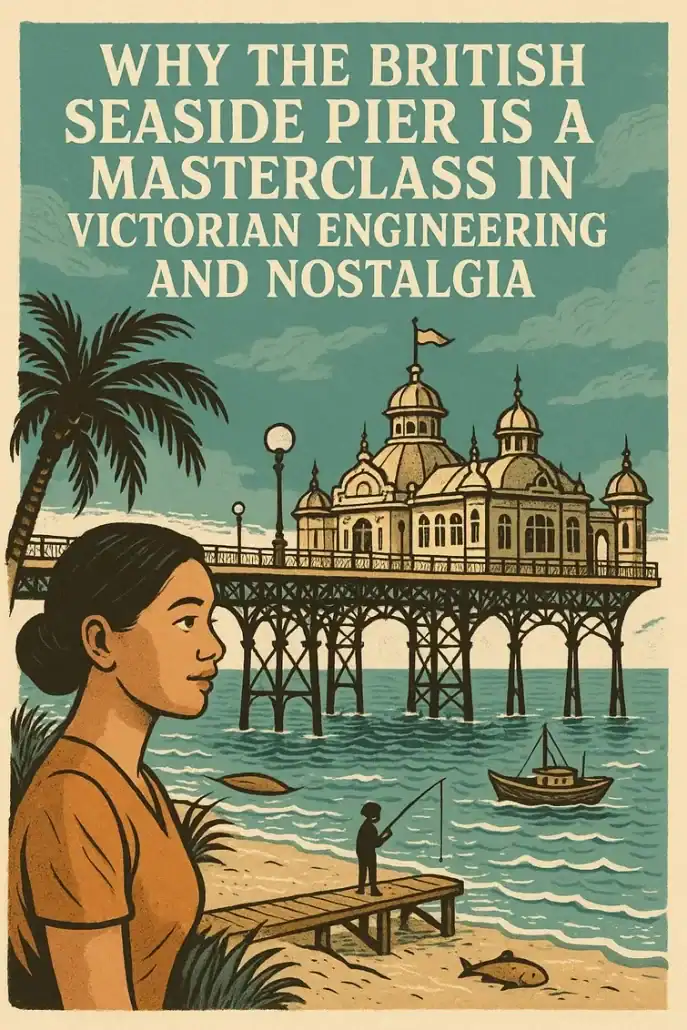
When I moved from Thailand to Britain, I thought the seaside meant palm trees, grilled squid on the beach, and maybe a long wooden jetty with fishing boats bobbing gently in the water. Then I met the British seaside pier. Suddenly I was walking on thin iron legs above grey waves, eating fish and chips while a storm tried to slap me in the face. And yet, this fragile-looking structure did not move. It just stood there, like it had been arguing with the sea for over 100 years and winning.
The more I learned, the more I realised: the British seaside pier is not just a cute place for selfies and arcade games. It is a serious masterclass in Victorian engineering, hidden underneath layers of candy floss, neon lights, and nostalgia. In Thailand, we build wooden piers and floating markets that dance with the water. In Britain, they screwed iron into the seabed and told the ocean, “You move around me.” This blog post explores why these Victorian piers are both engineering miracles and emotional time machines—and what they secretly share with Thai coastal culture.
The Architectural Paradox: Heavy Dreams on Spindly Legs
Let’s start with the obvious question: how on earth do these thin, spindly iron legs survive a century of corrosive saltwater, freezing winds, and angry winter storms? The British seaside pier looks delicate, almost too polite to fight with the sea. Yet it supports entire worlds of entertainment: theatres, ballrooms, fairground rides, and endless queues for fried doughnuts.
This is the architectural paradox of the Victorian seaside pier. Structurally, it is exposed to some of the most brutal conditions a building can face:
- Relentless waves attacking the piles day and night
- Saltwater corrosion eating away at metal
- Strong tides shifting sand and seabed
- Storm surges and occasional floating debris crashing into the structure
And yet, if you visit places like Brighton Palace Pier, Eastbourne Pier, or Blackpool North Pier, you will find families happily walking above the waves, barely noticing the violent physics happening below. The pier is a bridge between two worlds: the chaotic, unpredictable sea and the controlled, choreographed world of British leisure.
In Thailand, when we build jetties or sea-side walkways, we usually respect the sea in a different way. We often work with flexible materials like wood and accept that storms will come and damage things. We fix, rebuild, adjust. The Victorian British mindset was more like: “We have iron, math, and steam power. The sea will adjust to us.” This confidence (or stubbornness, depending on your mood) is what created the Victorian seaside pier—a structure that looks whimsical but is rooted in ruthless engineering logic.
The Hidden Engineering Beneath the Candy Floss
Walk along a British seaside pier and you’ll be distracted by noises: arcade machines shouting “Jackpot!”, children screaming on rides, and the constant call of “Fresh doughnuts! Candy floss!” But underneath this sensory overload is a quiet, invisible masterclass in structural design. Like a Thai curry, you taste sweetness first, but the complexity is hidden in the base of the sauce.
The secret weapon of many Victorian piers is the cast-iron screw pile. Instead of just hammering wooden posts straight down into the seabed, engineers began using long iron piles with spiral blades—like enormous metal screws. These were twisted into the sand and mud, anchoring the pier firmly in what looks like an unstable environment.
Behind all the fun at the fair, the British seaside pier is a precise answer to a serious engineering question: how do you build something solid on constantly shifting ground? The Victorians’ answer was both elegant and brutal—cast-iron, careful mathematics, and big, confident ideas.
The Screw-Pile Revolution: Alexander Mitchell’s Genius
The true hero behind the British seaside pier’s survival story is an Irish engineer named Alexander Mitchell. Interestingly, Mitchell was blind. Yet he designed a technology that allowed humans to walk further out to sea than ever before without getting wet or sinking into soft sand.
Mitchell invented the screw-pile foundation in the 1830s. Instead of just dropping a straight pole into the ground and hoping it would stay put, he designed a pile with helical plates at the bottom, like a screw. These screw piles were rotated into soft seabeds, providing:
- Stronger anchorage in sand and mud
- Better resistance to lateral (sideways) forces from waves
- Greater stability for lighter, more slender structures above
This technology was first used in lighthouses and river structures, then quickly adapted to seaside piers. Places like Southport Pier and later many others became practical thanks to screw-pile engineering. What looks like fragile iron legs are actually carefully distributed columns, each one gripping the seabed with a twisted iron hand.
In Thailand, we sometimes drive concrete piles or wooden posts into soft ground for houses, markets, and riverside restaurants—especially in flood-prone areas. But the scale is very different. Victorian Britain applied this idea to the open coastline, building long walkways that stretch far into rough seas. It’s like the difference between a local noodle stall on stilts by the canal and a floating airport runway out at sea the ambition is incomparable.
Mitchell’s invention allowed piers to be:
- Longer – reaching deeper water where ships could dock
- Lighter – using iron instead of heavy masonry
- More flexible – able to bend slightly with waves instead of breaking
This screw-pile revolution transformed not only engineering but also British society. Suddenly, the ocean was not just something you saw from the beach; you could walk into it, above it, surrounded by it, without being a sailor. For the first time, ordinary city workers could physically step into the middle of the seascape.
From Wood to Cast-Iron: When Industry Met the Sea
Before the Victorian era, coastal structures were usually made of wood—beautiful but vulnerable. Wooden jetties rotted, burned, and were easily smashed by storms. The Industrial Revolution changed everything by giving Britain mass-produced iron and, importantly, the confidence to use it aggressively.
In the mid-1800s, pier builders shifted from timber to cast-iron and wrought iron. This move was revolutionary because iron:
- Could be cast into complex shapes for decorative railings and columns
- Was stronger in slender sections, allowing piers to look light and elegant
- Worked well with screw-pile foundations
These materials allowed engineers to build longer, thinner walkways stretching out into increasingly deeper water. Iron piers became like skeletons: minimal material, maximum strength. The waves could pass freely through the structure, reducing the pressure on its legs.
In Thai coastal towns, wood was historically more available and more flexible than iron. Temples by the water, fishing platforms, and small jetties were built with local timber, bamboo, and sometimes stone. They aged, bent, and were rebuilt. In Britain, though, the rise of cast-iron created a very different relationship with the coastline. The pier became an industrial object placed in a natural environment, like a steam engine parked in the middle of the sea.
The industrial might of Britain in the 1800s—factories, foundries, railways—was not just about making weapons or bridges. It was also about leisure. Iron that could build a railway viaduct could also build a pier to carry tourists out above the waves. The same engineering that powered the Empire also powered the slot machines and seaside theatres.
Architectural Escapism: Orientalism, Exoticism, and Escaping the Factory
If the structure of the pier is engineering, its appearance is theatre. Many Victorian piers were decorated in styles that must have felt incredibly exotic to the average British worker in a smoky industrial city. You’ll see domes, towers, onion-shaped roofs, and intricate cast-iron patterns inspired by Middle Eastern, Indian, or “Oriental” fantasies.
For people living in crowded brick terraces and working in dark factories, the seaside pier was more than a day out. It was an escape fantasy in steel and iron. The designs screamed: “You are not in Manchester anymore. You are somewhere magical, sunny, and far from your boss.”
This is where, interestingly, I see a cultural echo with Thailand. In Thailand, when we go on holiday, we also love themed spaces—floating markets styled like old Ayutthaya, seaside cafés decorated like Santorini, hilltop temples with dragons and Naga statues winding down the stairs. We decorate our leisure time with fantasy. The British did exactly the same in the Victorian era, but they expressed it using:
- Cast-iron lacework balustrades and columns
- Glass pavilions and winter gardens
- Domes and turrets inspired by imperial imagination
Originally, many piers were simple landing stages for boats and steamers. People would arrive by sea, disembark, and then head to town. But over time, the pier stopped being just transport infrastructure. It evolved into a self-contained dream city above the waves—complete with theatres, music halls, restaurants, arcades, and fairground rides.
In a way, the pier is the Victorian version of a Thai night market on stilts: a concentrated world of food, games, lights, and music, separated from “normal life” by a symbolic distance. For British people in the 19th century, walking down the pier was like walking out of the factory and into another dimension where time moved slower and the sea breeze washed away the smell of coal smoke.
From Landing Stage to Floating City: How Piers Became Pleasure Palaces
The earliest piers focused on functionality—helping passengers get on and off steamers safely. But British leisure culture in the late 1800s was exploding. Paid holidays started to become more common for workers, and seaside towns competed to attract visitors. The pier became their secret weapon.
Developers and councils realised something clever: if you already had a walkway stretching out into dramatic sea views, why not turn it into a full entertainment platform? So gradually, simple decks gained:
- Concert halls and music pavilions
- Ballrooms and theatres
- Tea rooms and restaurants
- Later, amusement rides and roller coasters
The pier evolved from a transport node to a fantasy destination. Some piers became so loaded with attractions that the engineering had to adapt. More piles were added, decks widened, and structures reinforced to handle both the weight and the crowds.
In Thailand, if you go to a floating market like Amphawa or Damnoen Saduak, the water space is also transformed into an entertainment world: food stalls, souvenir shops, boat tours, and performances. But these are mostly built around the water, not out into the open sea. The British seaside pier took that idea and pushed it into deeper, more dangerous water—trusting their iron technology to make it feel safe.
The aesthetic of the pier always contrasted sharply with industrial Britain’s everyday reality. At home, people saw soot, brick, chimney stacks, and greyness. On the pier, they got colour, movement, music, and decorative detail. It was an intentional visual shock, like walking from a plain Bangkok office building into a temple festival packed with lanterns, gold leaf, and music.
Resilience Against the Elements: The War with Salt, Storms, and Fire
For all their charm, British seaside piers live a hard life. They stand in the most hostile place imaginable for a metal structure: the splash zone between air and seawater. This is where salt crystals, oxygen, and moisture all combine to supercharge corrosion. It’s like parking your motorbike in seawater mist every day and being surprised when it rusts.
Pier owners and engineers have to fight a constant maintenance battle. Some of the main enemies are:
- Saltwater corrosion – causes iron and steel to rust; structures have to be painted, coated, and regularly inspected
- Storm damage – high waves can rip off decking and damage piles
- Tidal scouring – flowing water can erode sand around piles, undermining their support
- Fire – many piers had wooden decks and buildings, making them vulnerable
- Ship collisions – in the past, steamers and other vessels sometimes crashed into them
Despite all this, some piers have survived for more than a century. How? One big reason is modular engineering. Many Victorian piers were built as repetitive bays—short sections that can be individually replaced or repaired. If a storm or collision destroys one part of the pier, engineers can rebuild just that segment instead of starting from scratch.
Several famous piers have survived disasters thanks to this approach. For example, piers like Brighton Palace Pier and Eastbourne Pier have endured fires, partial collapses, and constant storm damage, yet been rebuilt multiple times. The skeleton—the rhythm of iron piles marching into the waves—often stays, even when the buildings above change or disappear.
In Thailand, flooding and storms also shape how we think about coastal building. Houses on stilts, floating houses, and raised walkways all reflect a culture that negotiates with water. But British piers do something slightly different—they don’t just adapt to water; they confront it head-on, using industrial materials and strict geometry. It’s like watching a polite but firm argument between Victorian engineers and the North Sea, and surprisingly, the engineers often win.
Modern Maintenance: Keeping a 19th-Century Dream Alive in 2026
By 2026, many British piers are well over 100 years old. Looking after them is not cheap. Local councils, private owners, and heritage organisations all struggle with the same question: how much are we willing to spend to keep this delicate iron skeleton alive?
Maintaining a pier today involves:
- Regular underwater inspections by divers or remote-operated vehicles
- Ultrasonic testing of metal thickness to detect internal corrosion
- Replacing or reinforcing piles with modern steel or even concrete
- Applying advanced protective coatings and cathodic protection systems
- Structural strengthening to handle modern crowd loads and safety standards
At the same time, storms seem to be getting more intense, and sea levels are slowly rising due to climate change. For some piers, restoration costs climb into tens of millions of pounds. As a result, a few have been lost, while others survive thanks to campaigns, lottery funding, or the passionate love of local communities.
This is where nostalgia becomes an economic force. People do not fight to save a random rusty structure. They fight to save their childhood memories—the place where they held hands, ate ice cream, watched fireworks, or won their first 2p coin in an arcade. When you ask a British person about their favourite seaside pier, you don’t just get engineering facts; you get stories.
In Thailand, we also preserve structures that feel emotionally important, even if they are not the most efficient or modern. Old wooden markets, riverside communities, and heritage temples often survive because people feel they carry identity and memory. British seaside piers survive for similar reasons. Technically, many of them could be replaced by a simple concrete promenade. Culturally, that would feel like erasing a chapter of the nation’s heart.
The Future of Nostalgia: Why Piers Still Matter
So, why do British seaside piers still matter in 2026, when people can get cheap flights to Thailand, Spain, or anywhere with a more reliable sun? Why stand in a cold wind on a Victorian iron structure when you could be on a tropical beach in Phuket?
The answer is that the British seaside pier is not really competing with modern tourist destinations. It is competing with time. A pier is a living portal into a vanished era of leisure—the age of top hats, long dresses, brass bands, and Sunday strolls. Yet it has somehow absorbed new eras too: rock ‘n’ roll, mods and rockers, 1980s arcade culture, and today’s Instagram generation.
The pier continues to attract visitors because it offers:
- A tangible connection to ancestors and local history
- A sensory experience that mixes danger and safety (waves below, safety rails above)
- A space that is both public and slightly magical—“land, but not land”
- A unique view of the town from the sea, rather than just the sea from the town
In Thai culture, we talk about khwam song jam—memory, sentiment, the warmth of the past. British people feel something similar when they talk about “nostalgia.” A seaside pier is engineered nostalgia: iron piles, bolts, and beams turned into a cultural emotion. You can hear it in the way people say, “We used to come here every summer when I was little.”
21st-Century Technology Meets Victorian Iron
To keep the British seaside pier alive in the 21st century, modern technology has quietly joined the team. Engineers now blend Victorian engineering with contemporary tools and sustainable thinking.
Some of the innovations used to retrofit and protect piers include:
- Digital 3D scanning – creating precise models of the entire structure to plan repairs
- Modern anti-corrosion systems – like cathodic protection (using sacrificial anodes) to slow rusting
- Composite materials – fibre-reinforced polymers used in decks to reduce weight and resist rot
- LED lighting – lower energy use and dramatic night-time appearances
- Solar panels and greener energy – powering attractions and lighting more sustainably
Some piers are branching out into new roles: event spaces, heritage centres, performance venues, and even small hubs for marine research. Just as Thai floating markets evolve to include cafés, homestays, and cultural shows for new generations, British piers are learning to reinvent themselves while keeping their original spirit.
The irony (and the iron-y!) is that the very structures built during the peak of coal-powered, smoke-belching industrial Britain are now being gently upgraded for a world that cares about carbon footprints and climate adaptation. The pier stands as a reminder of a time when industry seemed unstoppable—but it’s being preserved by a generation more conscious of environmental limits.
British Piers and Thai Water Worlds: A Cross-Cultural Reflection
As a Thai person living in Britain, I cannot help comparing the British seaside pier to the water-based places I grew up with in Thailand. On the surface, they look very different: Victorian iron legs against grey water versus wooden stilt houses along green canals. But underneath, both cultures are doing something similar: creating human spaces on top of water to escape everyday life.
Consider these parallels:
- Thai floating markets – Boats, platforms, and stilted walkways become whole little towns of food and trade on canals.
- Riverfront communities – Houses on stilts, with families living at the boundary between land and water.
- Temple piers and jetties – Places where people step from land to boat and often to spiritual journeys.
All of these Thai examples show a cultural comfort with water as a habitat, not just a hazard. The British seaside pier does something similar but with a very different emotional flavour. Where Thai water spaces often feel integrated with nature and everyday life, the British pier is more of an event—a special trip, a treat, a performance.
Yet both Britain and Thailand share a deep understanding that water is a stage for human dreams. In Thailand, that dream might be a peaceful evening at a riverside market; in Britain, it might be a noisy night on the pier with flashing lights and the smell of fried fish.
What amazes me most is how Victorian engineers turned this dreamy idea into a hard reality using the technology of their time. They didn’t just imagine walking out over the sea; they calculated the loads, designed the piles, and invented new ways to fix iron into sand. Then they decorated the result with domes and railings so you’d forget how serious it all was.
Lessons from the British Seaside Pier
If we strip away the neon lights and the sticky ice cream fingers, the British seaside pier offers a surprisingly deep set of lessons—for engineers, historians, and anyone who just likes to look at waves from a safe distance.
Some of the key insights include:
- Engineering can create new kinds of leisure – Without screw piles and iron manufacturing, there would be no safe way to walk so far out over the sea.
- Design is about emotion, not just function – The Orientalist domes, decorative ironwork, and theatrical lighting are not “necessary” structurally, but they are essential emotionally.
- Resilience is a long game – Piers are constantly repaired, repainted, and refitted. Survival is not a one-time achievement; it’s a continuous process.
- Culture and technology are always linked – Victorian Britain’s industrial power made piers possible, but the desire for escape from industrial life made them popular.
- Nostalgia has real economic power – People donate, campaign, and spend money to keep these structures alive because they feel personally connected to them.
As someone from Thailand, watching British people defend their favourite pier reminds me of how we fight to protect old wooden shophouses, temples, or floating communities, even when developers say, “It would be easier just to build something new.” Sometimes, the “inefficient” structure is exactly the one that carries the soul of a place.
Conclusion: The Pier as Britain’s Iron Bridge Between Past and Present
The British seaside pier is one of the most fascinating contradictions I’ve encountered since moving from Thailand. It is both flimsy-looking and incredibly strong, playful and deadly serious, nostalgic and technologically advanced. Thin iron legs stand quietly in wild seas, holding up worlds of lights, music, and laughter.
From Alexander Mitchell’s screw-pile revolution to the cast-iron elegance of Victorian engineering, these structures turned dangerous coastlines into safe stages for working-class holidays and romantic strolls. Their Orientalist and exotic architecture offered escape from the smoke and noise of industrial cities, much like Thai floating markets offer escape from urban stress through water, food, and atmosphere.
Today, in 2026, British seaside piers are under pressure—from storms, from corrosion, from rising maintenance costs. Yet they continue to survive because they are more than just metal. They are emotional infrastructure, carrying memories across generations. Engineers now use digital scans, modern materials, and sustainable energy to keep this 19th-century dream standing, proving that nostalgia and innovation can work side by side.
For me, as a Thai person exploring British culture, the pier is a powerful symbol of how humans everywhere negotiate with water, time, and longing. In Thailand, we float markets and homes on rivers. In Britain, they screw iron into sand and build theatres over waves. Different materials, different moods—but the same desire: to step away from ordinary life and stand, just for a moment, between earth and water, looking out at a horizon that feels full of stories.
So next time you walk along a British seaside pier, listen for the creak of old iron and the crash of waves below. You’re not just on a tourist attraction; you’re walking across a masterpiece of Victorian engineering and a living monument to British nostalgia—one careful iron screw at a time.

Leave a Reply
Want to join the discussion?Feel free to contribute!